
Total cost of ownership
Licenses, implementation, integration, infrastructure, change, and the run cost most quotes leave out — modeled across the full horizon, not just year one.
Most ERP programs are pitched on a vendor quote and a promise. We build the case the board actually approves — total cost of ownership, a defensible benefits model, options compared on one basis, and NPV, IRR, and payback stress-tested against the downside.
A board doesn't fund a vendor quote. It funds a case that survives scrutiny.
The programs that get funded — and survive the first hard quarter — are the ones where the numbers were honest before a contract was signed.
Priced to win the deal
Built to survive the board
Every business case we build is assembled the same way — so the recommendation rests on evidence your finance function can pick up and stand behind.
Licenses, implementation, integration, infrastructure, change, and the run cost most quotes leave out — modeled across the full horizon, not just year one.
Hard benefits quantified — process efficiency, inventory, working capital, headcount — and soft benefits made explicit, with the assumptions behind every line.
Do-nothing, upgrade, re-platform, and best-of-breed compared on the same basis, so the recommendation is a choice the board can see, not an assertion.
NPV, IRR, payback, and ROI calculated to a standard your finance function will recognize and defend in front of the audit committee.
Downside, base, and upside cases that show how the numbers move when adoption slips or costs run — and where the case still holds.
The case is discounted for delivery risk, not presented at its rosiest. The board sees the realistic number, not the brochure one.
The deliverables are built to outlive the decision — the model finance owns, the deck the board approves, and the baseline you measure against once delivery starts.
The recommendation, the numbers, and the options — in the language and length an investment committee actually approves.
A transparent, editable model you keep — every assumption traceable, so finance can stress it and own it after we leave.
The benefits you committed to, structured so they can be tracked from day one — the case becomes the measure, not a forgotten document.
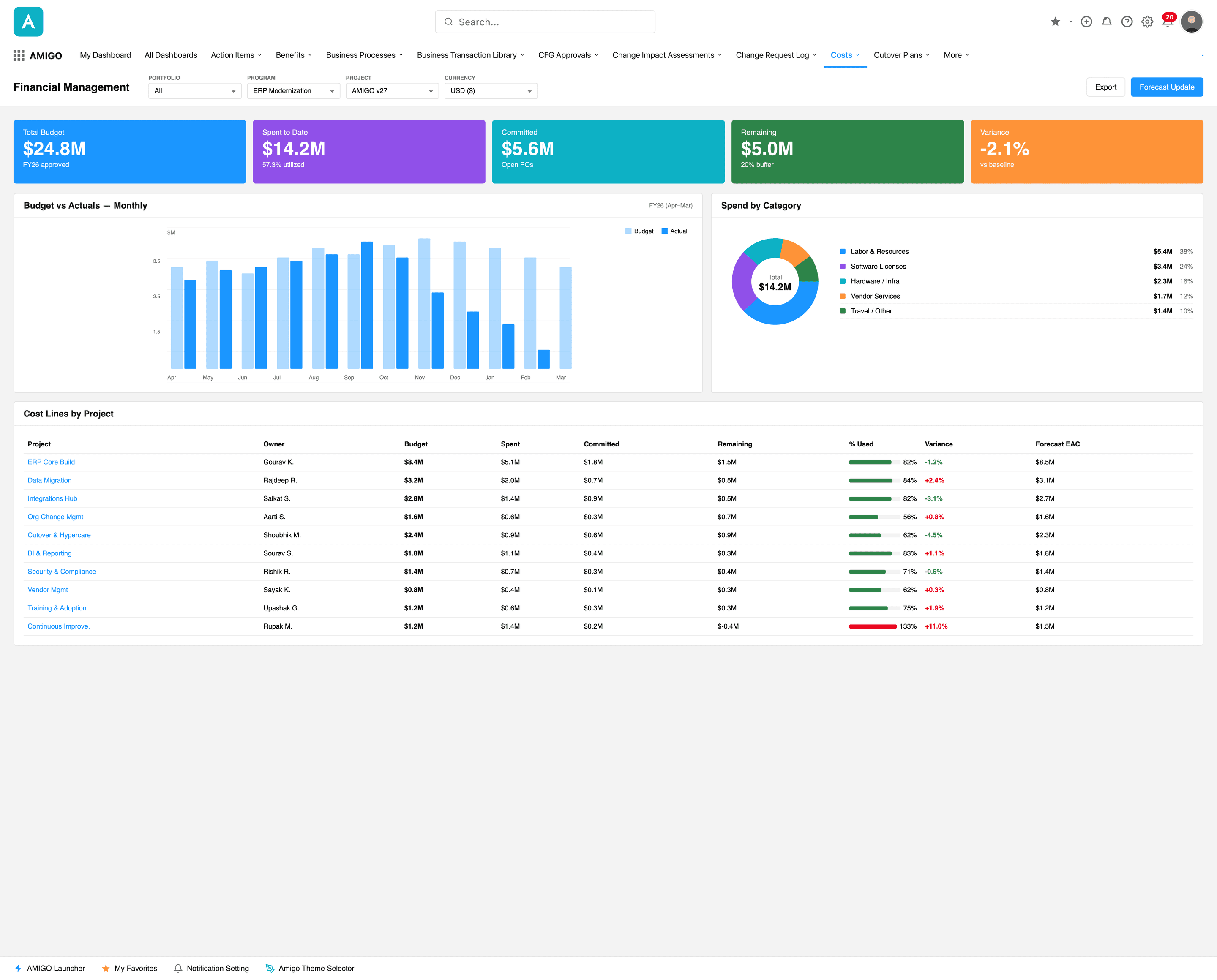
On most programs the business case is a slide deck that's never opened again — so nobody ever checks whether the benefits showed up. We load the case onto the AMIGO platform as a live benefits baseline, so the number you sold the board becomes the number you track.
Tracking realization is its own discipline — see Value Management.
Whether you're seeking funding, choosing between options, or defending a number to the audit committee, we'll build the case — and hand you the model to own it afterward.