
Scope
Uncontrolled change quietly eroding the baseline until the program no longer resembles the one that was funded.
The post-mortem always finds the warning signs. We run risk as a discipline, not a status color — identifying, quantifying, and mitigating it across every dimension of the program, with a live RAID register on AMIGO so the board sees exposure move in real time, not in hindsight.
Risk isn't a status color. It's a number with an owner and a plan.
Almost every failed ERP program has the same autopsy: the fatal risk was in someone's head, or buried in a register nobody scored. Risk management isn't predicting the unforeseeable — it's refusing to let the foreseeable go unowned.
It isn't the last step — it spans all of them. Every other ERP service carries risk, and this discipline is the thread that runs through the whole arc.
ERP risk doesn't live in one place — it spans the whole program, and the dimensions interact. We track all eight, because the dangerous risk is usually the one nobody owned.
Uncontrolled change quietly eroding the baseline until the program no longer resembles the one that was funded.
Critical-path slippage and timelines that were optimistic before they were ever committed.
Cost overrun, and the run cost most cases never budgeted for in the first place.
Poor source-data quality that hides until it surfaces — usually at cutover, at the worst time.
Interfaces failing at the seams where the new core meets every system around it.
A business that doesn’t use what’s delivered — the failure mode that voids the entire business case.
A system integrator under-delivering against the statement of work while the status stays green.
Performance, security, and architecture that hold in a demo but not at production scale.
A closed loop, not a quarterly ritual. Every material risk gets a number, an owner, and a plan — and the register is live, so nothing important goes quiet between meetings.
Structured identification across every dimension — from workshops and from the program’s own signals, not a once-a-quarter register refresh.
Each risk scored on likelihood and impact, and — where it matters — modeled in cost and schedule terms the board actually understands.
A named owner, a mitigation plan, and a contingency for every material risk — tracked to closure, not logged and forgotten.
Exposure tracked live on AMIGO, so early-warning signals surface before they become the issue nobody saw coming.
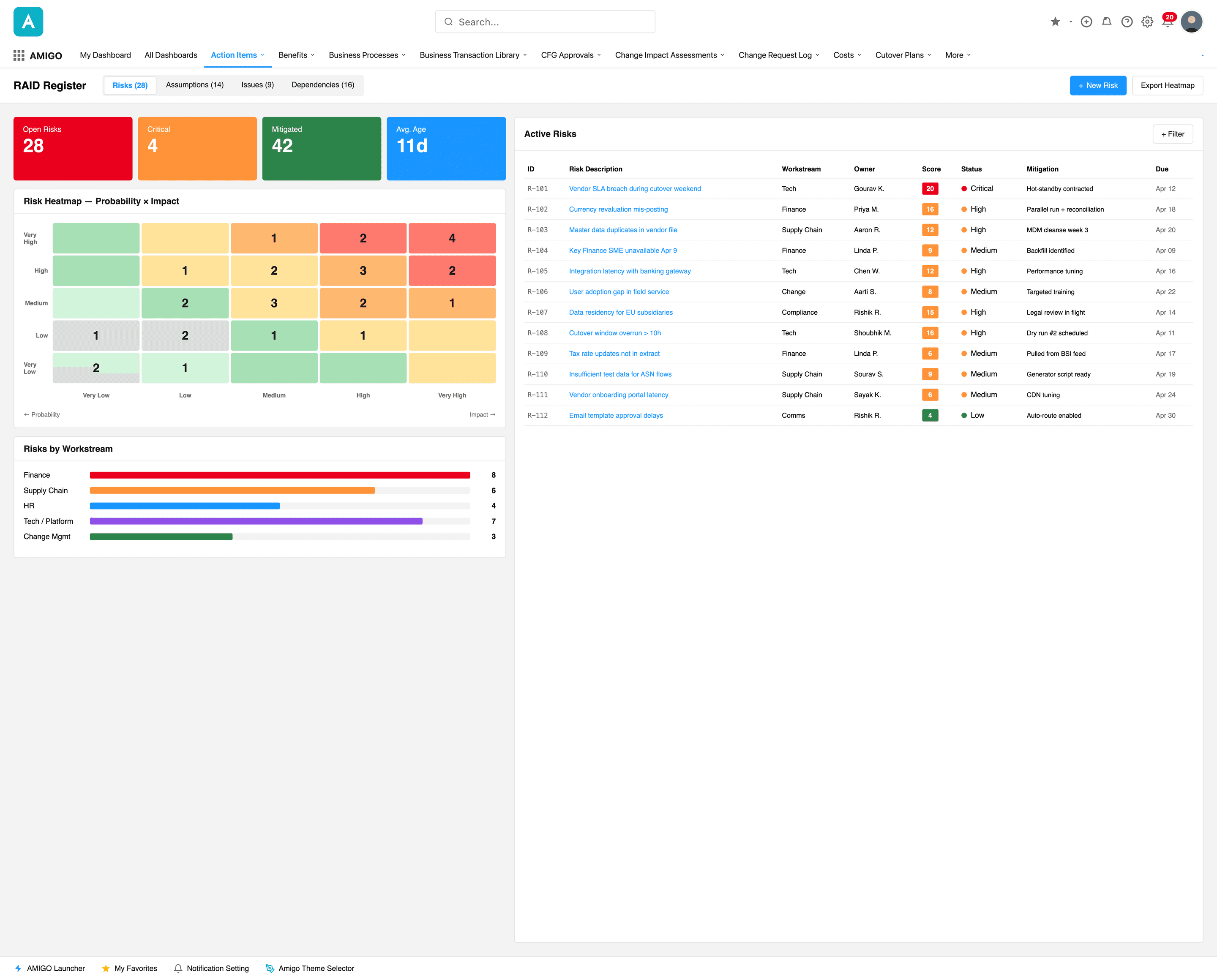
Most risk registers are a spreadsheet someone updates the night before steering. On AMIGO the RAID register is live — every risk scored, owned, and trending — so a rising exposure shows up on the heatmap when it changes, not when someone finally opens the file.
Starting a program or rescuing one, we'll run a structured risk assessment across all eight dimensions and stand up a live register your board can actually see into.